
Solution
Source Description
Transfer Path Analysis (TPA) often starts with characterizing the forces generated from an actively vibrating component – a process known as source description or source characterization.
Explore Source Description
Source characterization allows for creating independent descriptions of active vibration sources, such as blocked forces or blocked volume accelerations, which are independent of the receiving structure or environment. You can use these precise inputs to enhance CAE simulations, facilitate competitor benchmarking, and enable modular development by virtually transferring measurements from a test bench to the actual product. Through target cascading and Hybrid Modular Modelling, these source descriptions allow you to break down high-level system goals into specific targets for subsystems, ensuring individual components are optimized to meet overall performance targets. The following workflows and software unlock the full potential of this solution.
Blocked Force Source Characterization
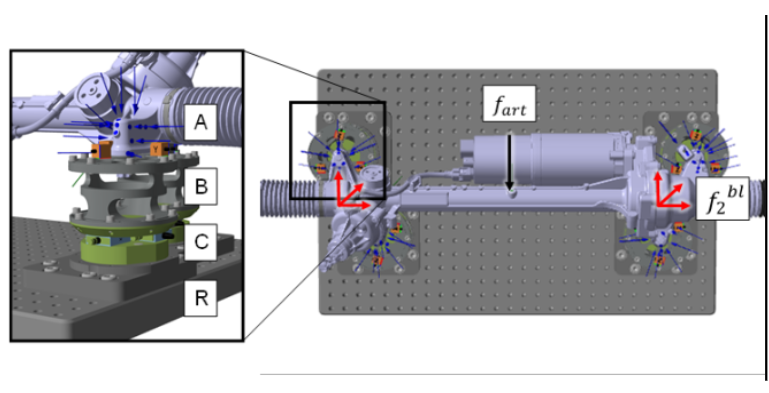
Source characterization involves creating descriptions of active vibration sources that are independent of the receiving structure, such as a test bench. This allows the data to be used in simulations or benchmarking across different products, teams and organizations. Various methods can be applied based on the specific source type, and the resulting descriptions can enhance collaboration and improve simulation accuracy. These characterizations can be used as precise inputs for CAE simulations and are more accurate when based on test data. Additionally, they can be obtained without detailed knowledge of the component (internal dynamics and complex excitation mechanisms), enabling benchmarking against competitor products.
Acoustic Source Characterization
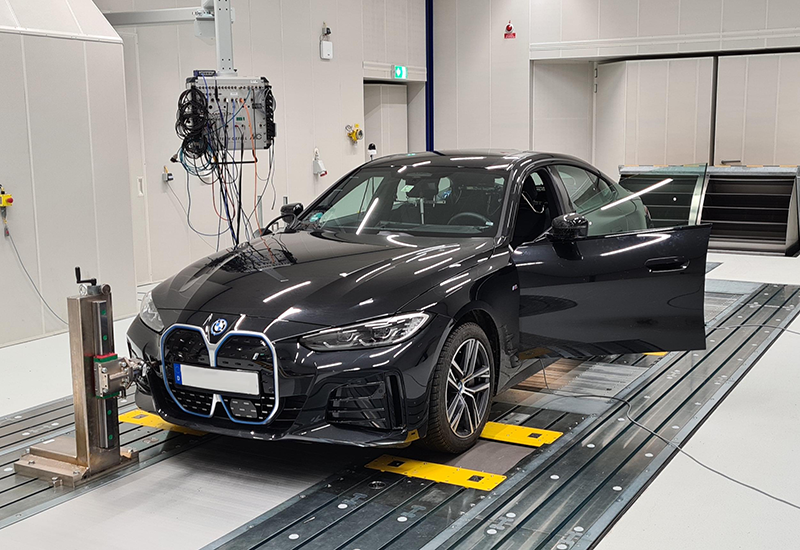
Active noise sources radiate sound directly from the vibrating housing of a component. This airborne contribution is what one would hear if the component, such as a compressor, were levitated without any physical connection to its surroundings. Traditional identification methods are often influenced by the environment, such as room acoustics. In contrast, using an equivalent airborne source description based on blocked volume accelerations provides receiver-independent data, enabling modular product development without interference from the surrounding environment. At VIBES we have developed a specialized technique to transfer such measurements correctly and efficiently from a test bench to the actual product.
Target Cascading
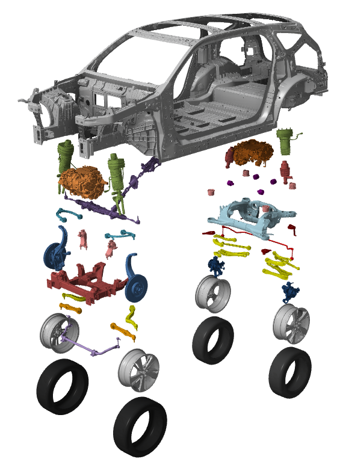
Target cascading is a systems engineering process that breaks down high-level system performance goals into specific targets for subsystems and components. Hybrid Modular Modelling substructuring and the use of blocked forces facilitate this process by enabling the independent optimization of subcomponents. These methods allow constant evaluation of how well subcomponents meet high-level system targets, ensuring that individual parts are optimized without compromising overall system performance. This approach ensures alignment across design levels and enhances the efficiency of modular product development.
How our solutions help others
Inspirational insights
VIBES is dedicated to solving many different types of sound and vibrations challenges, for a wide variety of companies.
Read some of our inspiring use cases and customer stories

Find out more
Implementing our solution
Ready to explore further? Request a demo, discover our services, or find out more about our other solutions.