
COUPLE
Predict assembly NVH behavior — before the first prototype
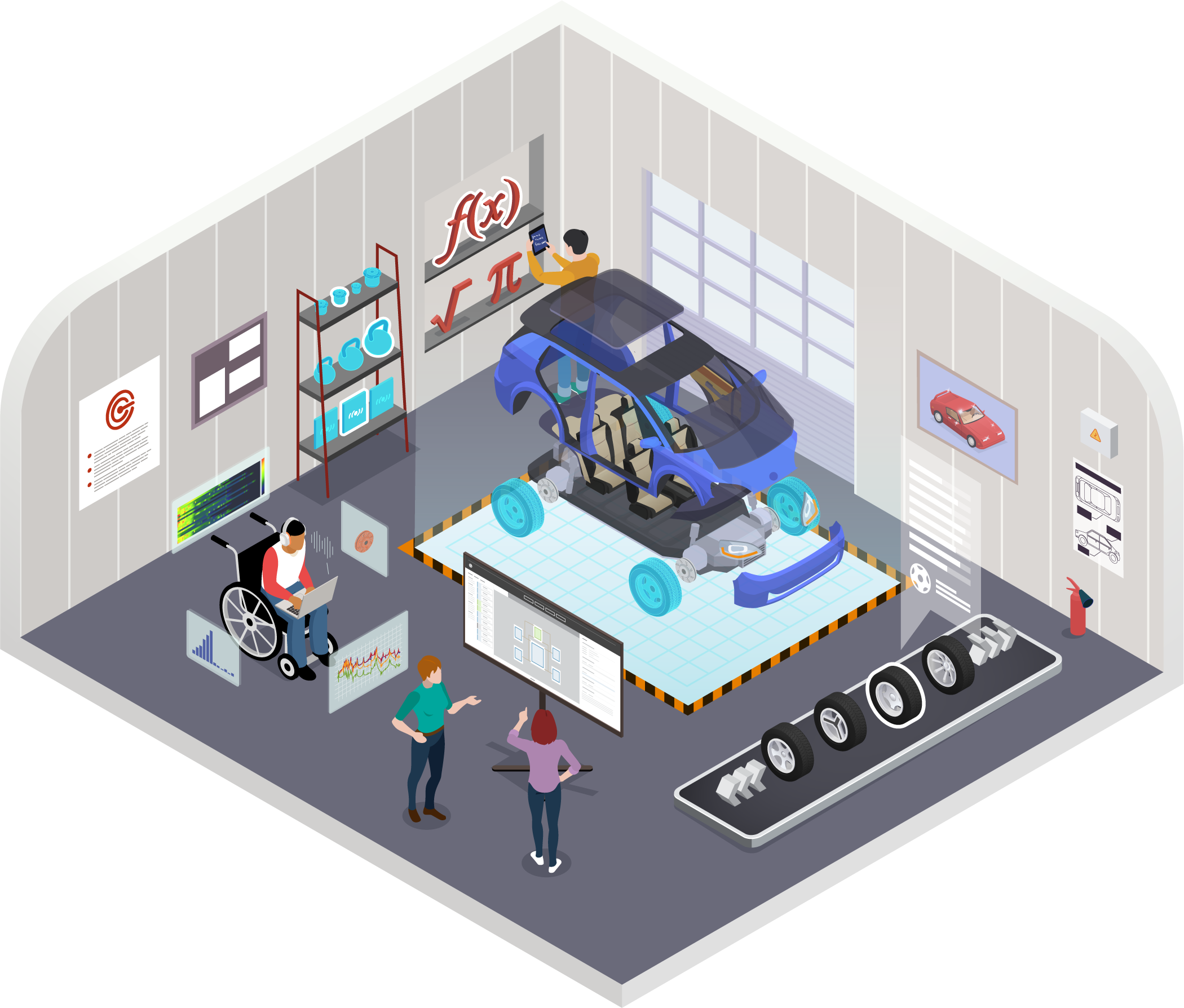
COUPLE is a modular assembly prediction software built on Frequency-Based Substructuring (FBS). It enables Noise, Vibration & Harshness (NVH) engineers to combine test-based models, CAE modal models, and parameterized components into a single hybrid assembly — and systematically explore how design changes affect system-level behavior. Where traditional simulation tools are limited to full-CAE assemblies and internal scripts handle one configuration at a time, COUPLE gives you a structured environment to evaluate hundreds of design variants before any hardware exists.
Explore COUPLE
COUPLE provides a dedicated environment for building, coupling, and analyzing modular dynamic assemblies using Frequency-Based Substructuring. Engineers import components from any source — Frequency Response Function (FRF) models from DIRAC, modal models from CAE packages, and blocked force source descriptions from SOURCE — and connect them on a visual assembly canvas. COUPLE handles different model representations transparently: modal models are automatically synthesized to FRFs at the interface, so test-based and numerical components mix freely in the same assembly without manual conversion. The variant and study framework lets engineers define component swaps and parameter ranges, then evaluate all combinations systematically — without rebuilding the assembly for each new design question. Results are calculated on demand: frequency response, Transfer Path Analysis (TPA) contributions, time-domain auralization, and operational deflection shapes.
Why Hybrid Modular Engineering Needs COUPLE
Hybrid Modular Engineering requires combining test-based and CAE component models into a single assembly prediction — a capability that traditional simulation tools do not provide. Without a dedicated environment, teams either accept the accuracy limitations of full-CAE simulation or build internal MATLAB and Python scripts that work for a single calculation and break under every new design question.
Typical challenges in hybrid assembly prediction include:
- Full-CAE assembly models lose accuracy in the mid-frequency range, making high-frequency NVH predictions unreliable
- Validated component models — whether from internal measurements or supplier deliveries — cannot be systematically reused across assembly configurations or projects
- Test-based and CAE models maintained in separate workflows, with no consistent way to combine them
- Each new design question requires reworking the calculation setup, slowing down the engineering cycle
- No systematic way to explore design alternatives — decisions are made on too few configurations, too late in development
COUPLE was built to close this gap: a purpose-built FBS environment where hybrid assemblies are modular by design, variants are systematic, and every prediction is grounded in test-quality data.
A New Realm for Hybrid Modular Engineering
COUPLE expands the Hybrid Modular Engineering workflow with capabilities that improve both flexibility and efficiency. Engineers can now work directly with modal models for tighter integration of CAE-based data, while parametrized models introduce a powerful way to control and adapt assembly behavior without rebuilding models.
Together with workflow and performance refinements across the software, these capabilities enable faster iteration, clearer assembly setup, and more reliable analysis when working with complex hybrid systems.
Modal Models
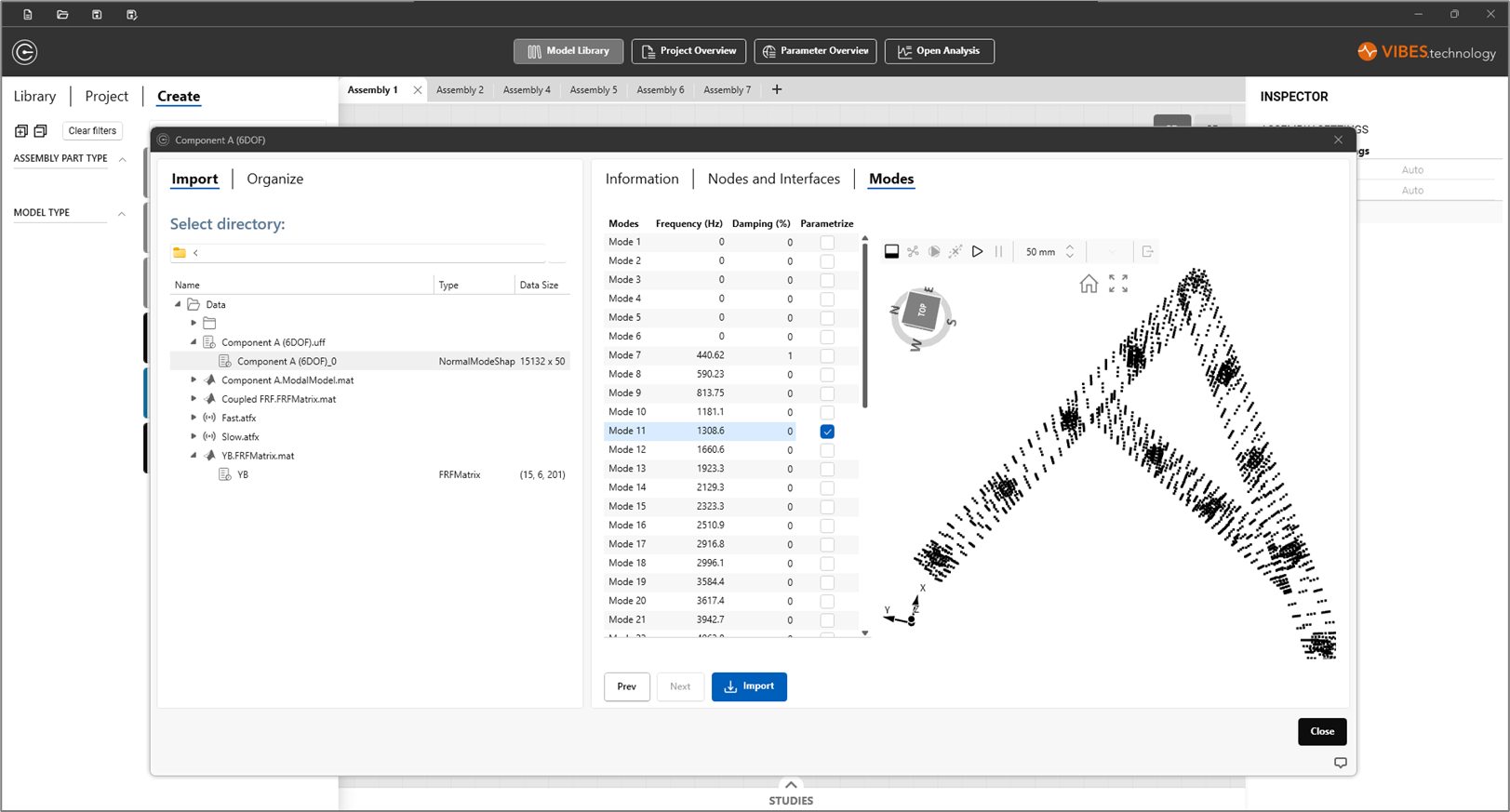
COUPLE supports the direct use of modal models, allowing numerical models to be converted into FRF representations and applied seamlessly in Frequency-Based Substructuring. This closes the gap between test and simulation by enabling hybrid assemblies that combine measured and simulated components within a single framework.
Key benefits include:
- Seamless integration of CAE-based models into substructuring workflows
- Transparent inspection of nodal data and interface definitions
- Flexible creation of interfaces using nodes or Virtual Point transformations
These capabilities ensure efficient setup and reliable coupling, even for large numerical models and complex geometries.
User Parameters and Parametrized Models
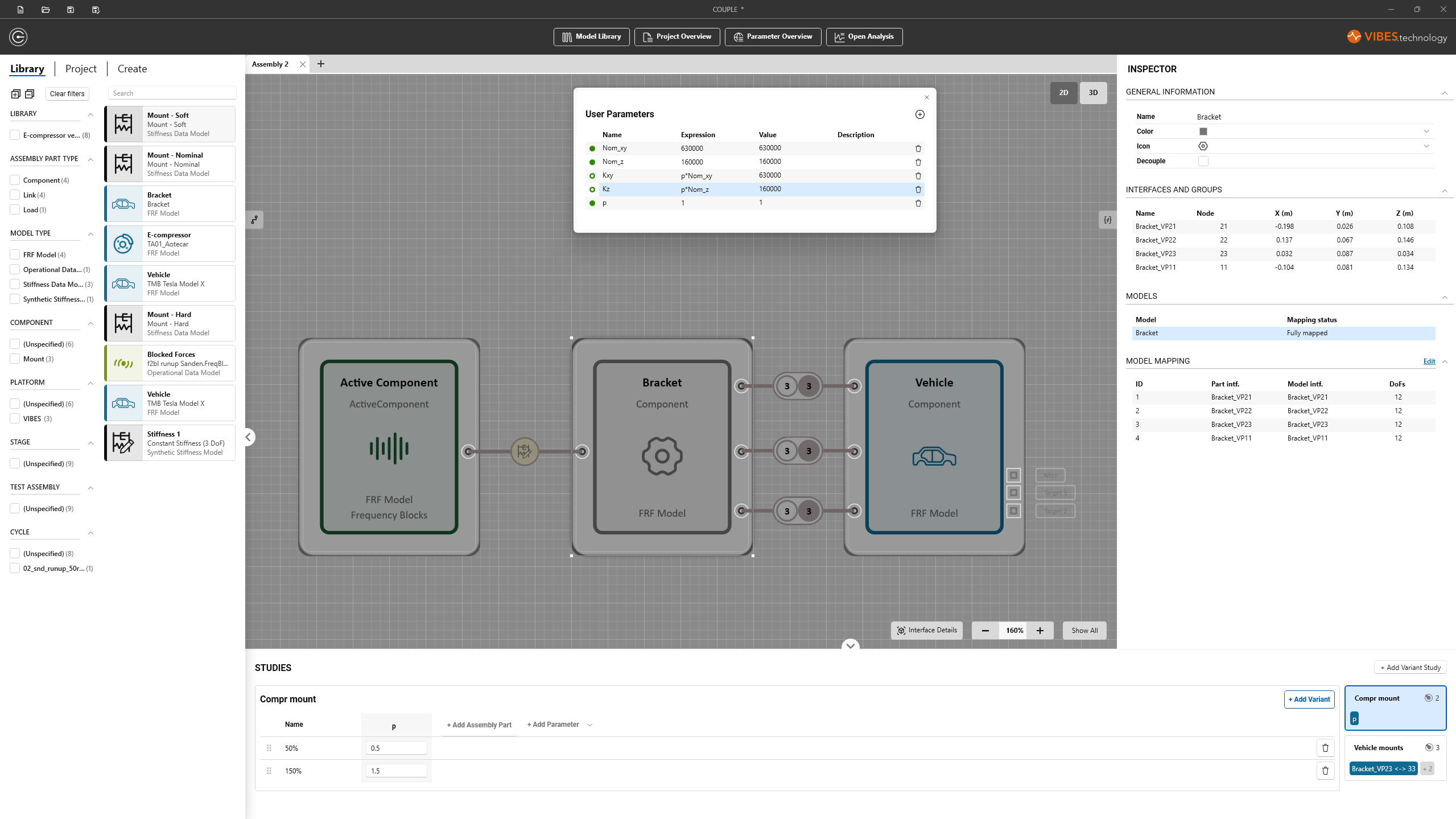
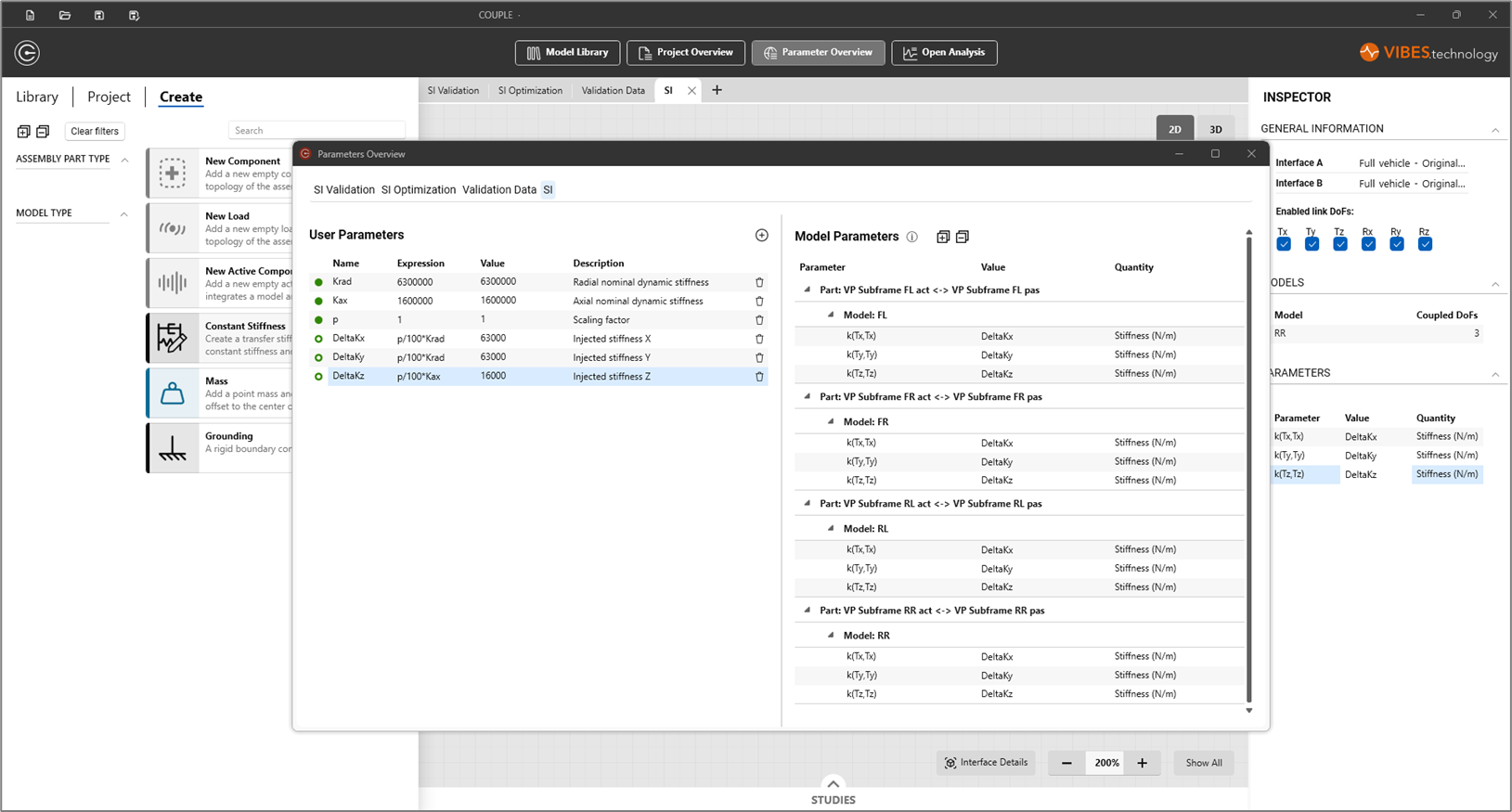
COUPLE allows engineers to define User Parameters that control key properties of an assembly. These parameters make it easier to capture design intent, express dependencies, and maintain consistency across variants.
Parametrized models enable engineers to:
- Adjust mass, stiffness, damping, or modal properties without rebuilding models
- Define scaling relationships and symmetry constraints
- Tune assembly behavior directly through exposed model parameters
This approach supports fast, focused iteration and efficient refinement of hybrid assemblies.
Parametric Variants
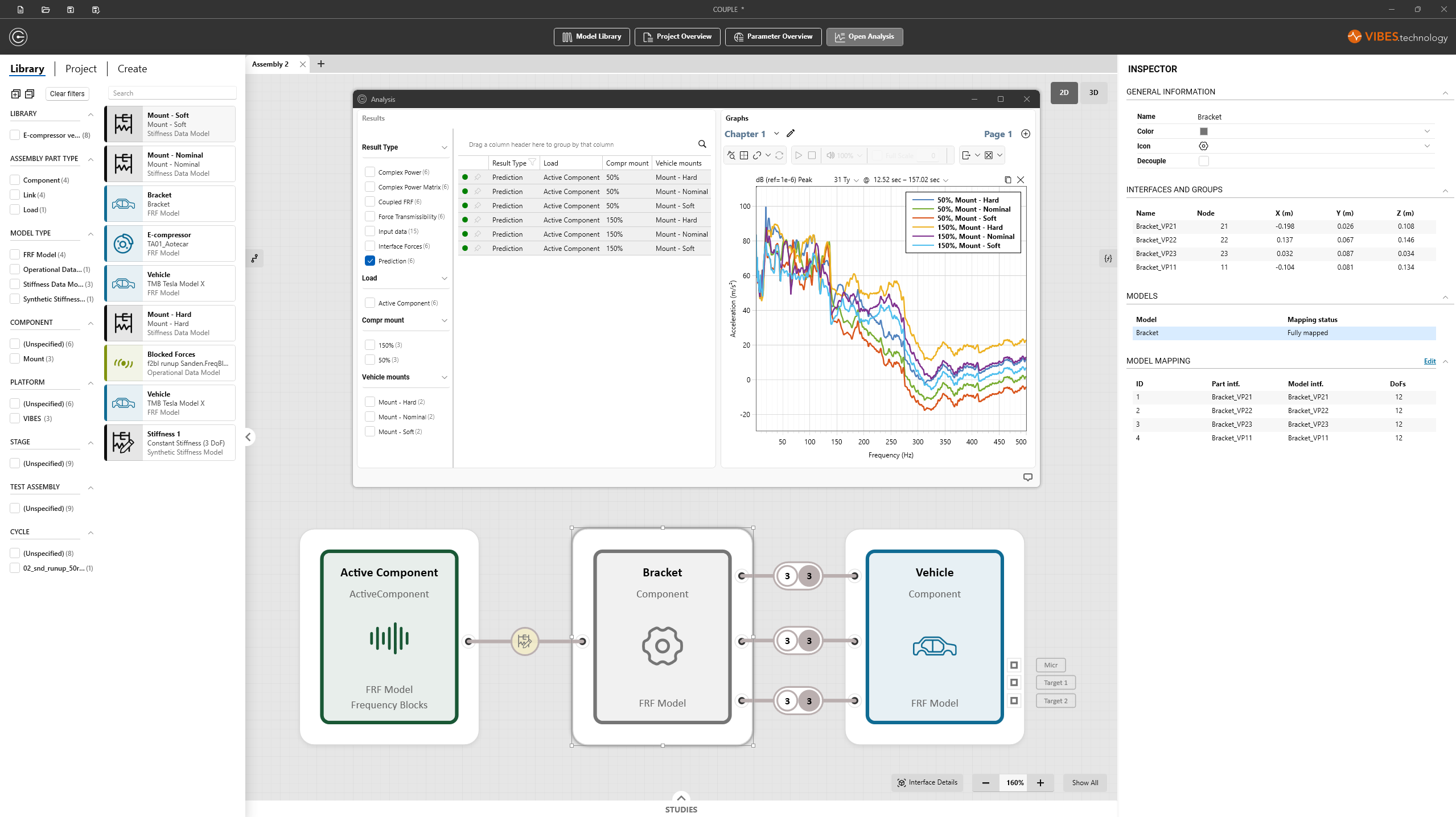
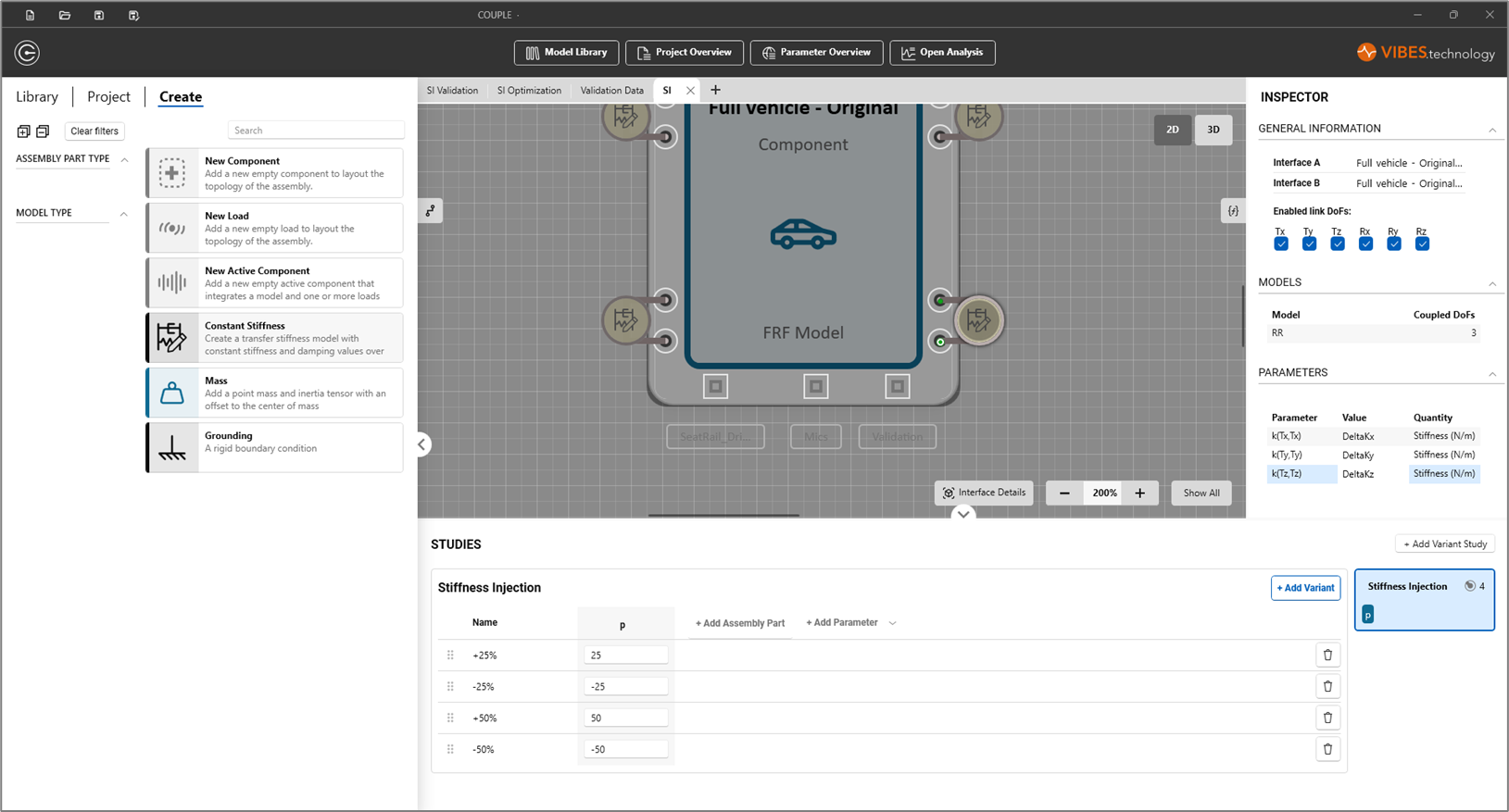
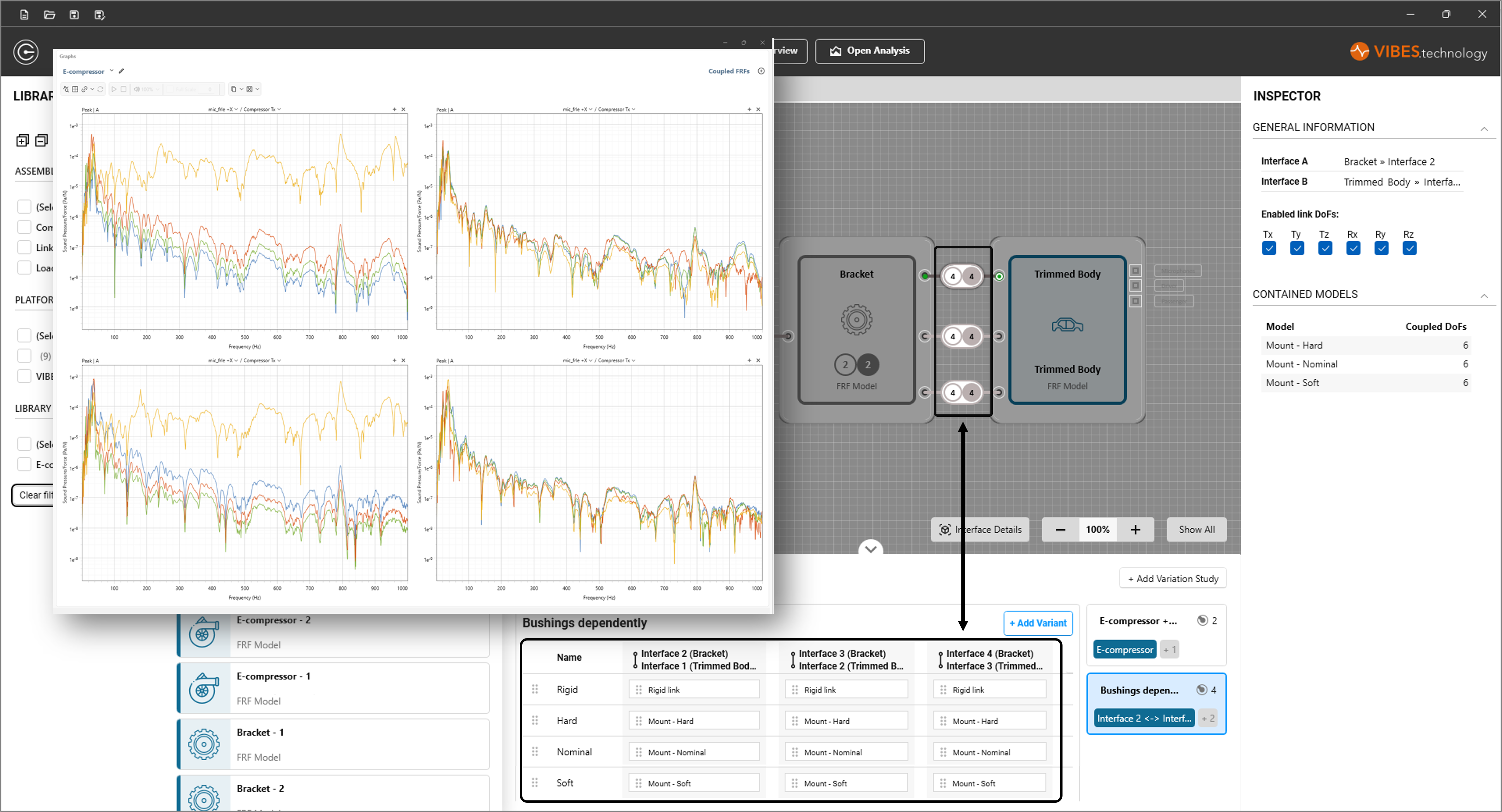
Building on the new parametrization framework, COUPLE allows user-defined parameters to be included directly in variant studies. Engineers can combine different models, parameter values, and configurations to generate comprehensive design tables in a structured and traceable way.
With centralized frequency settings and improved handling of large result sets, parametric variants can be explored efficiently, enabling rapid design space exploration and informed decision-making early in the development process.
Active Components
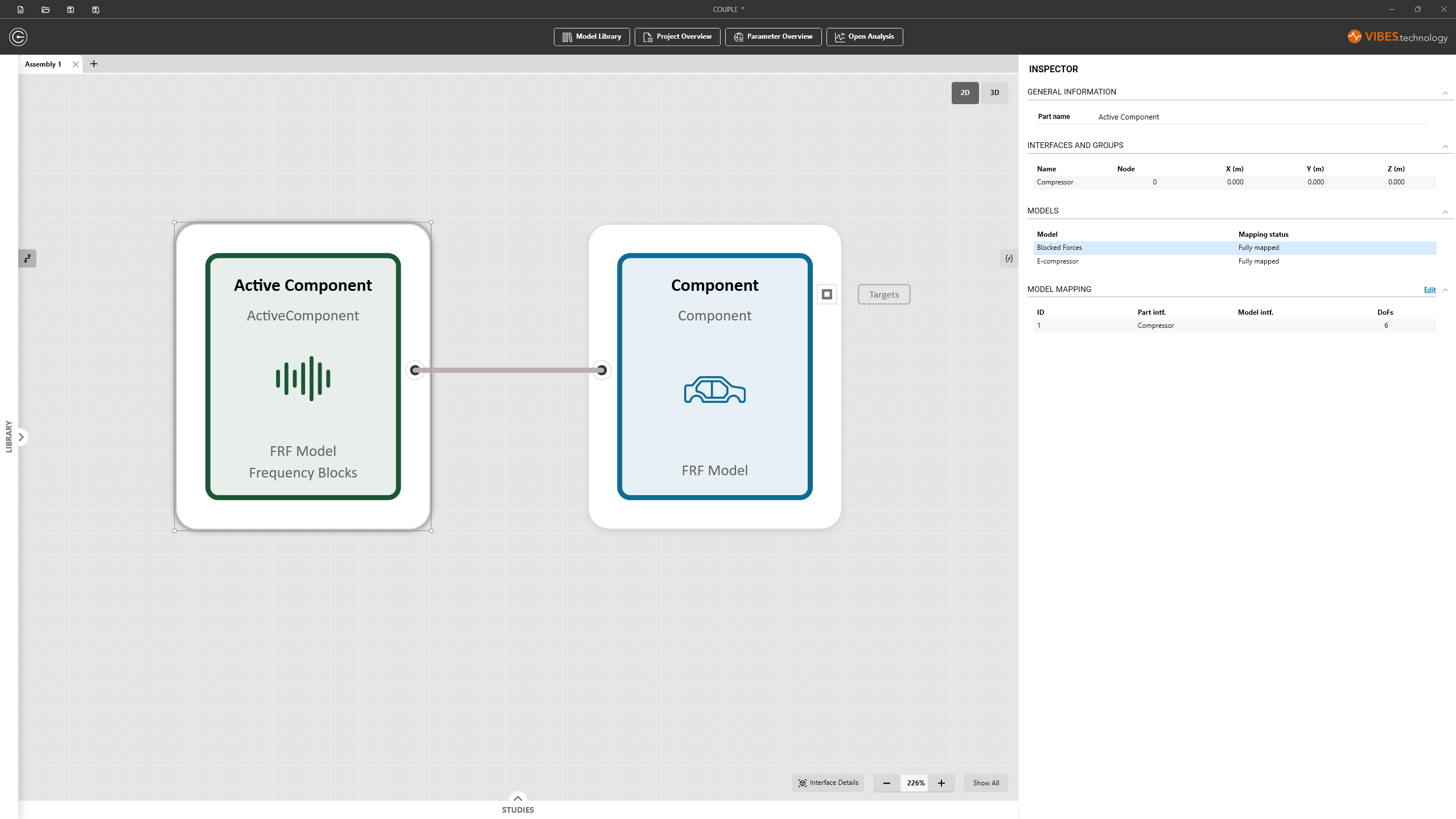
Active Components simplify assembly design by combining component models with their operational loads into a single, self-contained item. This reduces visual clutter and streamlines common Hybrid Modular Engineering workflows.
With Active Components, engineers can:
- Manage multiple operating conditions within one assembly part
- Keep complex assemblies clear and easier to maintain
- Focus on engineering decisions rather than model bookkeeping
This structured approach supports clarity and scalability when building and analyzing hybrid assemblies.
What Engineers Say
When Expertise Meets Application
Inspirational insights
Curious how COUPLE supports Hybrid Modular Engineering in real projects? Explore how Frequency-Based Substructuring, hybrid assemblies, and parametric studies help teams connect test and simulation more effectively.
Find out more
COUPLE: Build once. Explore endlessly.
COUPLE sets the foundation for Hybrid Modular Engineering by enabling flexible, modular, and parametric assembly modeling. Ready to go further? Discover how our services support your NVH programs, explore real-world applications, or dive into the full feature set in the COUPLE Product Guide.