
Solution
Modal Analysis
Use Modal Analysis to determine the natural vibration characteristics of a structure or system, specifically its natural frequencies, mode shapes, and damping ratios
Explore Modal Analysis
Modal Analysis allows you to determine the natural vibration characteristics of a structure or system, specifically its natural frequencies, mode shapes, and damping ratios. Using Experimental Modal Analysis (EMA), you can find system poles through specialized algorithms and manual pole picking to obtain mode shapes of your test-based models. These results facilitate comprehensive model validation by comparing physical and simulated models through mode shapes and MAC matrices, enabling you to improve modeling techniques and make design changes with confidence without additional testing. The following workflows and software unlock the full potential of this solution.
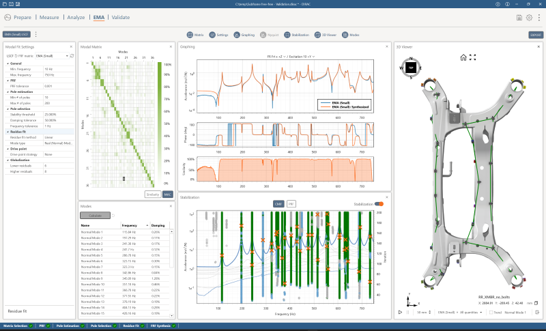
Experimental Modal Analysis
In DIRAC, you can perform experimental modal analysis to obtain the mode shapes of your test-based model. The PRF (Principal Response Function) algorithm, combined with the LSCF, is used to find the poles of the system. In the EMA module you can define the desired preset from which you want to obtain modes. The smart settings are set by the software to help you out, but you can also edit them manually to fit your needs. Different drive point strategies are available as well as fit types. Manual pole picking is also possible to improve your results. Multiple results are available; from the list of all modes, to the mode shape viewer in the 3D environment, to similarity and MAC matrices. All results can be used in the Validate module to compare EMA results with simulation one, if a reference model is imported.
Model Validation
Model validation involves comparing physical, test-based models with simulated models through their mode shapes to assess the accuracy of a simulated component. This process is used to research and improve modelling techniques through model updates and to identify modelling assumptions that may lead to misleading results, allowing for design changes with confidence without additional testing. To support this, our goal was to develop the most integrated, fast, and visually intuitive solution on the market, specifically optimized for the most common modal comparison workflows.
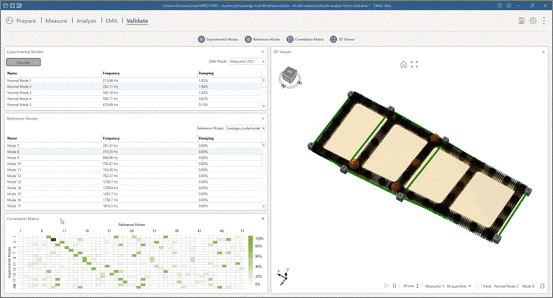
Our software for Model Analysis:
- DIRAC: a new, efficient way for test-based sound & vibration measuring
How our solutions help others
Inspirational insights
VIBES is dedicated to solving many different types of sound and vibrations challenges, for a wide variety of companies.
Read some of our inspiring use cases and customer stories


Find out more
Implementing our solution
Ready to explore further? Request a demo, discover our services, or find out more about our other solutions.