Innovation
Webinar Series: Hybrid Modular Engineering Academy
16 November 2026
Advanced NVH Engineering Academy is a webinar series on Hybrid Modular NVH Engineering, where VIBES experts discuss and present the latest developments in modular NVH methodologies. Each session is approximately 45-minute long, and it runs twice on the same day, at 08.30 and 16.00 (CET), so you can join from anywhere!
Episode 1 - COMING UP
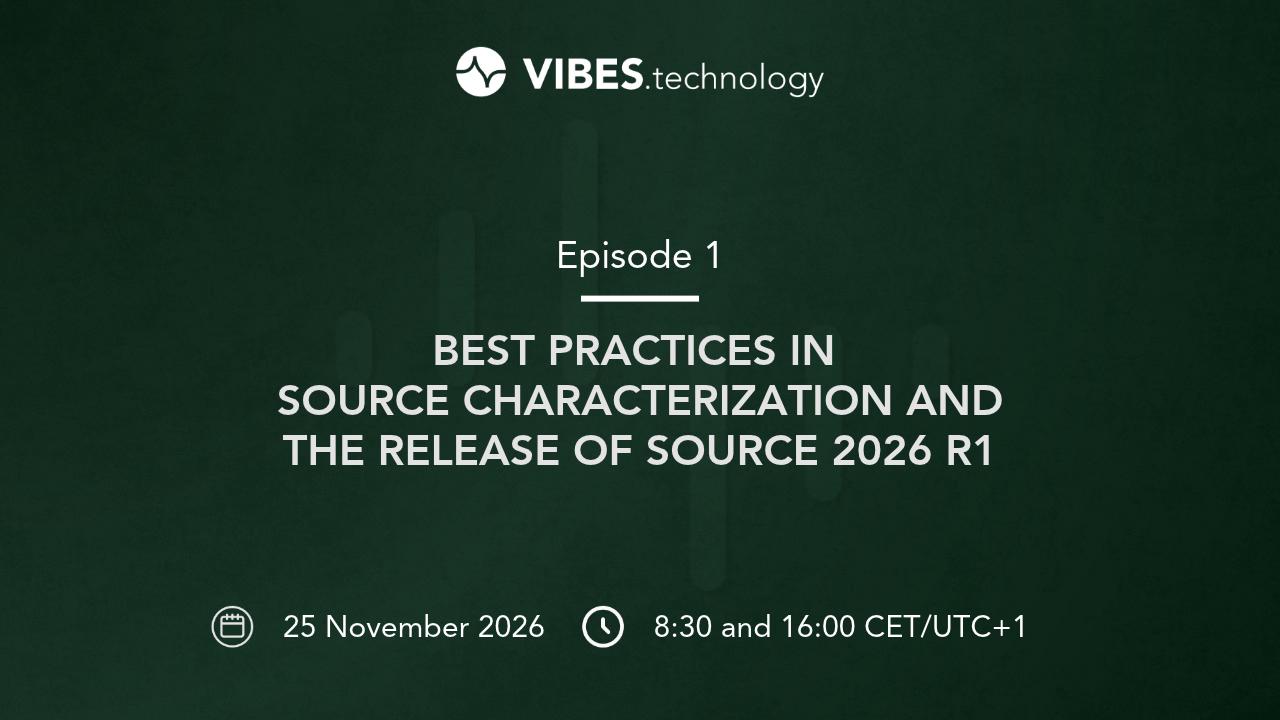
Best practices in TPA and Source Characterization + the release of SOURCE 2026 R1
- Date: 25 November, 2026
- Time: 08.30 & 16.00 (CET)
On Wednesday, 25 November, we will organize a 45-minute webinar on the state-of-the-art source characterization workflow, following the release of SOURCE 2026 R1.
Blocked forces give you a source description that is independent of the receiver, so you can reuse it across design iterations without retesting. Getting there reliably takes more than a measurement. It depends on choosing the right method, defining the interface well, using a robust inverse, and having validation you can stand behind.
In this webinar, Maarten will walk you through the complete source characterization workflow, from choosing a method to delivering validated blocked forces. He will also show how the new SOURCE 2026 R1 release supports this workflow, with more TPA methods available as Standard Analyses, Chained Analyses for multi-stage workflows, and new validation and diagnostic tools for ISO 20270.
What’s covered
- TPA framework: classic vs. component-based Transfer Path Analysis (TPA), and when each applies
- Source characterization strategies: in-situ blocked force estimation, interface definition and virtual point modeling
- Matrix inversion strategies in source characterization, including the patented X-DoF inverse
- Validation per ISO 20270: the quality indicators you can put in front of a customer
What you’ll learn
- How to choose the most effective source characterization method for the component and the program
- How different test bench configurations affect the validity of the result
- How to run the end-to-end process robustly, with the right quality checks at every step
- The implications of the inverse: when it is reliable, when it is not, and how to act on the difference
- How to apply the ISO 20270 standard
Join Maarten for this webinar, ask your questions and discover what SOURCE 2026 R1 brings to your workflow.
Save your spot today and register for one of the following timeslots!
Episode 2
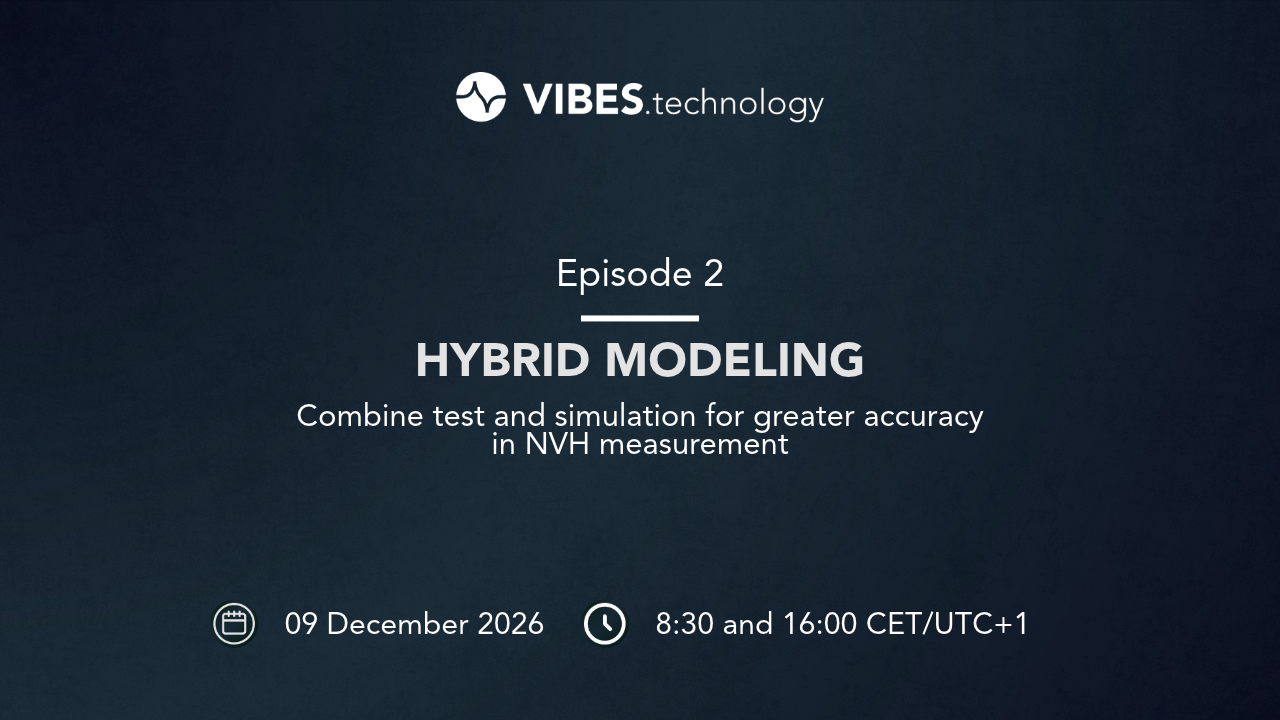
The Release of Hybrid Modeling - Combine test and simulation for greater accuracy in NVH measurement
- Date: 09 December, 2026
- Time: 08.30 & 16.00 (CET)
On 09 December 2026, we will organize a 45-minute webinar on hybrid modeling: training your CAE (computer-aided engineering) model with measured test data. We will hold the same webinar twice on the same date, at 8:30 (CET) and 16:00 (CET time).
Your CAE model has the details. Your test data has the dynamics. A hybrid model has both. A hybrid model combines your CAE model with a limited set of FRF (frequency response function) measurements. The result keeps the resolution of your simulation and follows the measured dynamics of the physical part, so you can change the design anywhere.
What’s covered
- Theory: how training brings the measured dynamics into your CAE model;
- Workflow in DIRAC: building a hybrid model from a CAE model and measured FRFs;
- Methodology: where hybrid models fit alongside source characterization, component TPA (transfer path analysis) and dynamic substructuring.
What you’ll learn
- How to design a measurement for a hybrid model: spread sensors and impacts over the component, and excite only where you can reach;
- How to train a hybrid model, from measurement to application;
- How to get complete six-DoF (degrees of freedom) interfaces that are valid to higher frequencies;
- How to apply hybrid models in source characterization, component TPA and dynamic substructuring, including blocked forces where the mounts can’t be directly excited.
Join Eric for this webinar, ask your questions and see how the test data you already collect for validation can become part of your CAE model.
Save your spot today and register for one of the following timeslots!